Wellness Protocol Documentation: A Methodological Framework for Professional Recovery

The difference between elite recovery and mere physical exertion lies not in the intensity of the effort, but in the precision of the data captured. Most dedicated professionals recognize that a protocol without a rigorous record is a variable that cannot be controlled or replicated. Implementing a structured wellness protocol documentation system is the only way to transform subjective feeling into objective, actionable methodology. You likely understand that without this granular level of tracking, it's impossible to identify the exact physiological triggers that drive performance or to detect the subtle deviations that precede a systemic failure.
This article provides a comprehensive methodological framework designed to eliminate the logistical instability and lack of consistency that often plague high-stakes recovery environments. You'll master the standards required to maintain protocol integrity, ensuring that every physiological response is documented with the precision required by modern regulatory shifts, such as the FDA’s January 2026 guidance on general wellness products. We will examine the specific components of a repeatable documentation chain, the critical distinction between wellness and clinical claims, and the logistical strategies necessary to secure your professional recovery infrastructure.
Table of Contents
The Role of Documentation in Professional Wellness Protocols
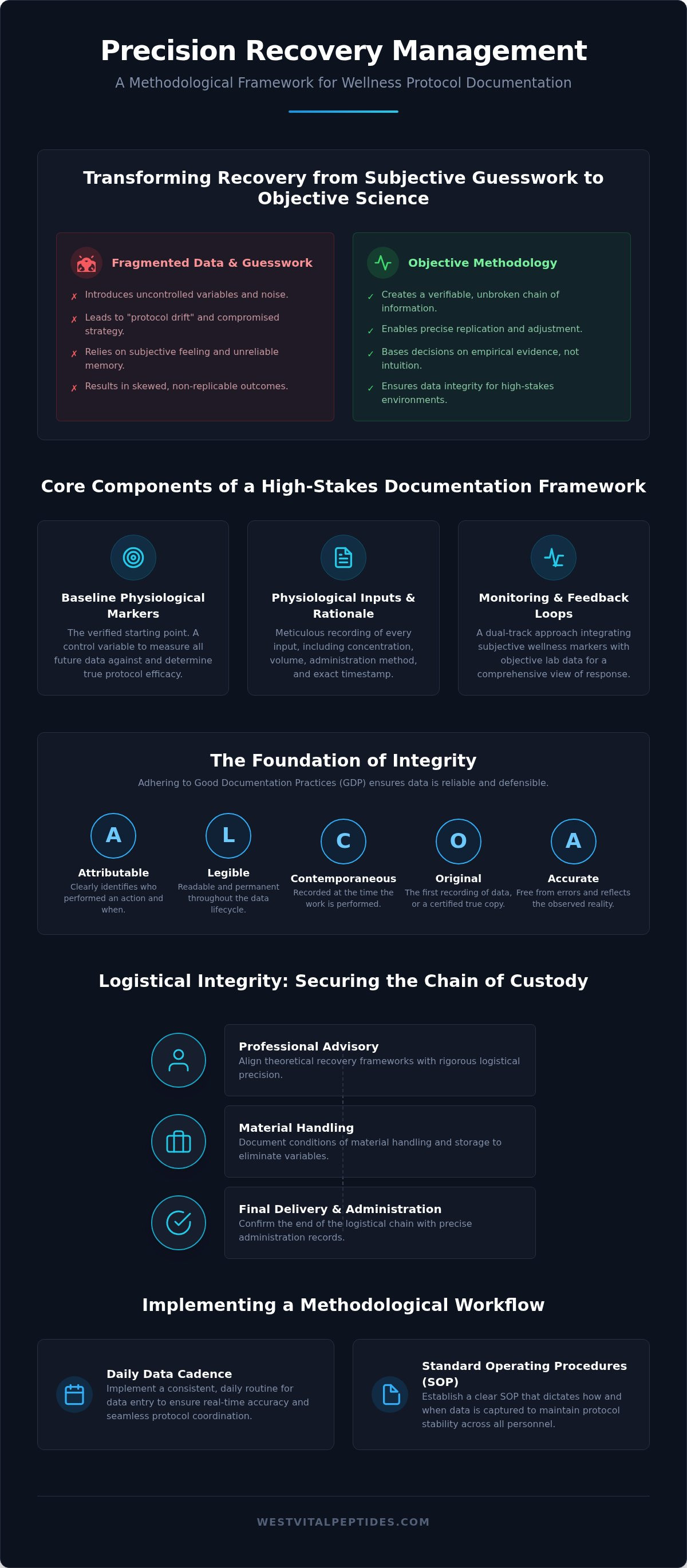
Wellness protocol documentation serves as a rigorous, methodological record that captures every physiological input and logistical variable within a recovery cycle. This documentation acts as the foundational bedrock of precision recovery management, providing the data necessary to evaluate the efficacy of specific interventions. Without a structured record, recovery remains anchored in subjective observation; with it, the process shifts toward an objective, data-driven methodology. This transition allows professional teams to maintain absolute transparency and accountability, ensuring that every protocol adjustment is based on empirical evidence rather than intuition. Precision is the only standard that matters in high-stakes environments.
Integrity as a Foundational Principle
Rigorous recording is the primary defense against protocol drift, a phenomenon where small, undocumented changes over long-term cycles eventually compromise the entire recovery strategy. This approach mirrors the scientific method, where every action must be supported by a recorded rationale to allow for successful replication or precise adjustment. To achieve this level of consistency, teams must implement a Standard Operating Procedure (SOP) that dictates how and when data is captured. These procedures ensure that the protocol remains stable across different environments and personnel. Consistency is the byproduct of discipline.
The Risks of Fragmented Data
Incomplete records create blind spots that undermine the integrity of the entire wellness protocol. Informal tracking methods often suffer from significant gaps, particularly regarding the timing and administration of recovery tools. Missing logistical data, such as the exact timestamp of an input or the conditions of material handling, can lead to skewed physiological outcomes that are difficult to diagnose. Memory is a notoriously unreliable tool for elite performance management; it fails to capture the nuances required for high-stakes decision making. Relying on recollection introduces noise into the data set. Professional recovery demands a complete, unbroken chain of information to ensure that logistical precision matches physiological ambition. Data integrity is non-negotiable.
Effective wellness protocol documentation requires a commitment to detail that extends beyond simple logging. It demands an understanding of how each recorded variable interacts with the body's mechanics and the overall logistical chain. By prioritizing this level of transparency, professionals can ensure that their recovery strategies are both repeatable and scalable, regardless of the complexity of the environment.
Core Components of a High-Stakes Documentation Framework
Establishing a high-stakes framework requires a move away from generic logging toward a system that captures the interplay between administration and physiology. Effective wellness protocol documentation begins with the establishment of baseline physiological markers. These markers serve as the control variable against which all future data points are measured. Without a verified starting point, it's impossible to determine if a protocol is yielding the desired results or if the body is merely reacting to external stressors. Precision starts at the foundation.
Physiological Input and Rationale
Precision depends on the meticulous recording of every input. This includes the exact concentration and volume of recovery tools, along with the specific administration methodology utilized. To ensure institutional reliability, professionals should adhere to Good Documentation Practices (GDP), which emphasize that data must be attributable, legible, contemporaneous, original, and accurate. Time-stamping every administrative action is critical. A five-minute delay in administration might seem negligible, but when tracked over a twelve-week cycle, these variances can obscure the true efficacy of the intervention. Understanding the specific rationale behind each adjustment ensures that the protocol remains a deliberate scientific inquiry rather than a series of guesses.
Monitoring and Feedback Loops
Tracking the body's response requires a dual-track approach that integrates both subjective wellness markers and objective lab data. While lab results provide the hard data needed for mechanical analysis, structured methods for recording subjective feedback, such as perceived exertion or sleep quality, offer context to the physiological numbers. Environmental variables, including ambient temperature and travel-related stressors, must also be logged to account for external influences on recovery. A protocol feedback loop is a critical tool for iterative adjustment that allows for the real-time refinement of inputs based on captured physiological data. This structured approach prevents the accumulation of errors that lead to protocol drift.
Maintaining this level of detail requires a disciplined commitment to the methodology. For those navigating the complexities of high-stakes environments, seeking professional advisory and logistical support can provide the necessary framework to ensure documentation reflects the true integrity of the process. Capturing the "how" and "why" behind every action projects the image of a meticulous expert who leaves nothing to chance. When data is fragmented, results are inconsistent. When documentation is rigorous, the path to elite performance becomes a repeatable sequence of events.
Logistical Integrity and Chain of Custody Documentation
The physical integrity of recovery tools is a prerequisite for protocol efficacy. If the materials utilized have been compromised by environmental stressors, the data captured in the final wellness protocol documentation becomes inherently flawed. Professional recovery demands an unbroken record of the supply chain, moving from the initial professional advisory phase to the moment of secure delivery. This logistical transparency ensures that every physiological reaction can be traced back to a stable, verified input. Without this level of detail, researchers and professionals risk attributing outcomes to the wrong variables.
Peptide logistics management represents a methodological framework for maintaining this material stability throughout the entire lifecycle of a protocol. It's not enough to record the administration; one must also document the precise conditions that preceded it. This includes the verification of cold-chain logistics and the tracking of FedEx milestones to ensure that handling procedures remained within established tolerances. When logistical data is missing, the integrity of the entire recovery cycle is called into question. Precision must be maintained from the laboratory to the end user.
Stability and Material Integrity
Temperature tracking is a non-negotiable component of high-stakes protocols. Records must include the date of reconstitution and the precise expiration windows for all materials to prevent the use of degraded components. Light exposure is another variable that requires standardization in the log, as UV sensitivity can rapidly alter molecular stability. Cold-chain logistics verification provides the objective proof that the material arrived in its optimal state. Standardizing these logs ensures that every team member can verify material integrity at a glance. Stability is the foundation of reliability.
Professional Advisory Oversight
Specialized logistical assistance notes should be integrated directly into the primary wellness log. This ensures that professional advice is documented alongside the physical movement of materials, creating a comprehensive record of the strategy and its execution. Maintaining a clean chain of custody isn't just an administrative task; it's a fundamental requirement for research and recovery integrity. This documentation allows for the identification of potential logistical failures before they impact physiological data. A meticulous record of advisory oversight projects the image of a disciplined specialist who leaves nothing to chance. Transparency is the ultimate safeguard against error.
Implementing a Methodological Workflow for Protocol Oversight
A documentation framework is only as effective as the discipline of its execution. To maintain the integrity of a professional recovery cycle, one must establish a daily cadence for data entry that ensures real-time accuracy and eliminates the risk of retrospective bias. This methodological approach transforms wellness protocol documentation from a passive record into an active management tool. By utilizing peptide protocol coordination, teams can align individual actions with broader strategic objectives, ensuring that every member operates from a unified data set. Precision isn't an occasional requirement; it's a constant obligation.
The Daily Documentation Cadence
The workflow for data capture must be integrated into the protocol itself to ensure no variables are omitted. An effective cadence follows a structured, three-step sequence to maintain the accuracy of the log. First, a pre-administration checklist is used to verify the environment, material integrity, and current physiological state before any action is taken. Second, the professional performs real-time recording of the precise volume, concentration, and timestamp at the exact moment of administration. Finally, post-administration response logging captures immediate physiological feedback or local reactions within a predefined window. This sequence prevents the data gaps that occur when professionals rely on end-of-day recollections. Standardizing nomenclature across these steps is also essential to prevent ambiguity in multi-person teams. When every stakeholder uses the same technical definitions, the risk of miscommunication is minimized. Clarity is a prerequisite for safety.
Review and Optimization Cycles
Data capture is the first phase; analysis is the second. Periodic protocol reviews allow teams to identify trends and anomalies that may not be apparent during daily entry. Weekly data audits are essential for detecting protocol drift, where minor deviations begin to accumulate into systemic errors. Monthly deep-dives should compare physiological markers against the logistical inputs recorded in the log. This rigorous analysis provides the evidence required to adjust strategies with confidence. If the documented data doesn't reflect the intended efficacy, the protocol must be refined based on empirical evidence rather than anecdotal observation. For those seeking to establish this level of institutional reliability, West Vital Peptides LLC offers logistical assistance and professional advisory to bridge the gap between protocol design and disciplined execution. Every adjustment must be a calculated response to the data.
Professional Advisory and Logistical Support for Protocol Execution
The execution of a sophisticated wellness protocol requires more than a standard template; it demands an expert hand to navigate the myriad variables inherent in elite performance. Specialized advisory services bridge the gap between theoretical recovery and the practical realities of high-stakes environments. West Vital Peptides facilitates this logistical precision by providing the institutional reliability that retail-focused providers simply cannot offer. When a protocol involves complex physiological inputs, the margin for error narrows significantly. Professional guidance ensures that your wellness protocol documentation reflects a disciplined adherence to methodology rather than a series of uncoordinated actions. Expert oversight is the only way to maintain the integrity of a high-performance system.
The Value of Disciplined Mentorship
Leveraging Coach West’s expertise in physiology and mechanics provides teams with a level of oversight that transcends basic logging. Disciplined mentorship ensures the integrity of the wellness protocol documentation by verifying that the recorded rationale aligns with established scientific foundations. This advisory role is particularly critical when navigating the logistical complexities of secure material handling and cold-chain verification. Requesting specialized logistical assistance allows professionals to focus on performance while the underlying supply chain remains transparent, secure, and verifiable. Expertise is the primary mechanism for mitigating risk and ensuring that the "how" and "why" behind every action are clearly defined. A mentor's role is to ensure that the process remains as precise as the desired outcome.
Strategic Planning for High-Performance Teams
Customizing a documentation framework for specific physiological goals is essential for any high-performance team. A generic log fails to capture the nuances of individual body mechanics or unique environmental stressors that influence recovery cycles. By aligning your documentation with established physiological recovery strategies, you create a system that is both predictive and reactive. This alignment ensures that every data point captured serves a strategic purpose in the larger recovery architecture. The integration of expert oversight into your existing framework transforms your records into a verifiable account of institutional excellence. Precision is not a goal; it's a requirement for those who prioritize data over trends. Contact West Vital Peptides for professional advisory services and logistical support to ensure your protocol execution meets the highest standards of professional recovery.
Standardizing Excellence through Methodological Oversight
Masterful recovery is contingent upon the conversion of physiological data into a repeatable, transparent framework. This guide has outlined the necessity of establishing baseline markers, the imperative of cold-chain logistics, and the implementation of a disciplined daily data cadence. Implementing rigorous wellness protocol documentation ensures that every intervention is supported by a verifiable record; this effectively eliminates the variables that lead to protocol drift and logistical failure. Precision is the only acceptable standard in high-stakes environments.
West Vital Peptides provides the institutional reliability required for such precision. By combining specialized expertise in physiology and body mechanics with rigorous logistical standards, we ensure that your documentation reflects the true integrity of your supply chain. Our methodological approach to high-performance recovery is designed for those who prioritize data over trends. We invite you to inquire about Professional Advisory and Logistical Support to align your recovery infrastructure with the highest standards of excellence. Success is the byproduct of meticulous preparation and absolute transparency.
Frequently Asked Questions
What are the most critical data points to include in wellness protocol documentation?
The most critical data points consist of baseline physiological markers, precise administration volumes, and exact timestamps for every input. These variables allow for the objective evaluation of a recovery strategy by providing the necessary context for physiological feedback. Documentation should also account for environmental variables such as ambient temperature and light exposure during storage to ensure material stability remains uncompromised.
How does documentation impact the stability of peptide-based recovery tools?
Documentation impacts stability by providing a verifiable record of reconstitution dates and storage conditions. By tracking these variables, professionals can determine the exact degradation timeline of materials. Maintaining a log for cold-chain logistics ensures that materials haven't exceeded thermal thresholds during transit. This level of wellness protocol documentation is essential for maintaining the scientific validity of the recovery process.
Why is a methodological approach better than informal tracking for athletes?
A methodological approach is superior to informal tracking because it removes the subjectivity and memory lapses that undermine data integrity. Informal methods often fail to capture the subtle deviations that lead to protocol drift over long-term cycles. Professionals require a structured record to identify precise correlations between logistical inputs and physiological responses. Discipline in recording is the foundation of institutional reliability.
Can documentation help identify errors in protocol logistics?
Rigorous documentation allows teams to identify logistical errors by highlighting deviations from established handling and shipping procedures. By cross-referencing FedEx milestones with internal temperature logs, professionals can pinpoint disruptions in the supply chain. This transparency ensures that compromised materials are identified before they impact the protocol. Identifying these failures is critical for maintaining the integrity of the recovery infrastructure.
How often should protocol documentation be reviewed by a professional advisor?
Protocol documentation should be reviewed by a professional advisor at least once per week to identify and correct any emerging protocol drift. These weekly audits ensure that the daily cadence of data entry remains accurate and consistent. Monthly deep-dives are also necessary to evaluate long-term trends and align physiological outcomes with the broader strategy. Regular oversight prevents the accumulation of small errors that compromise performance.
What is the difference between clinical compliance and professional protocol integrity?
Clinical compliance focuses on meeting regulatory standards and mitigating legal risks within a practice. Professional protocol integrity prioritizes the precision, repeatability, and outcome of the recovery methodology itself. While compliance is a baseline requirement, integrity demands a more granular level of documentation regarding the specific mechanics of administration and logistical stability. It's the pursuit of elite performance through data-driven discipline.
How do I document the chain of custody for secure peptide shipping?
Documenting the chain of custody requires an unbroken record that begins with the professional advisory phase and continues through to secure delivery. Each logistical milestone, including FedEx handling procedures and cold-chain verification, must be captured in the primary log. Professionals should record the condition of the materials upon arrival and verify that they remained within established environmental tolerances. This meticulous record ensures research and recovery integrity.
Is software required for effective wellness protocol documentation?
Software isn't a requirement for effective wellness protocol documentation; the primary variable is the discipline and methodological rigor of the user. A physical log that adheres to Good Documentation Practices (GDP) can be just as effective as a digital system if it's updated contemporaneously. The focus must remain on the accuracy, legibility, and completeness of the data captured. Methodology must always take precedence over the tool used for recording.



Comments