Maintaining Molecular Integrity: A Reference Guide to Peptide Stability Logistics

A single degree of temperature variance or a minor logistical oversight can render a precise recovery protocol entirely void. For the dedicated professional, the efficacy of a peptide sequence is only as robust as the chain of custody that delivers it; however, the industry frequently lacks the transparency required to verify that these standards are maintained. Uncertainty regarding shipping conditions creates a tangible risk of protocol failure due to degraded materials. This technical exploration addresses the critical necessity of peptide stability logistics to safeguard the molecular integrity of your recovery assets.
You likely recognize that precision in application is meaningless if the foundational materials have been compromised during transit. This guide provides a comprehensive understanding of the environmental factors and logistical methodologies required to preserve peptide stability throughout the recovery protocol lifecycle. We will analyze the specific mechanisms of peptide degradation, establish rigorous criteria for evaluating logistical integrity, and offer a structured framework for professional protocol management. By adopting a disciplined approach to logistics, you ensure that every component of your recovery strategy remains viable and effective.
Table of Contents
The Science of Peptide Stability: Understanding Molecular Fragility
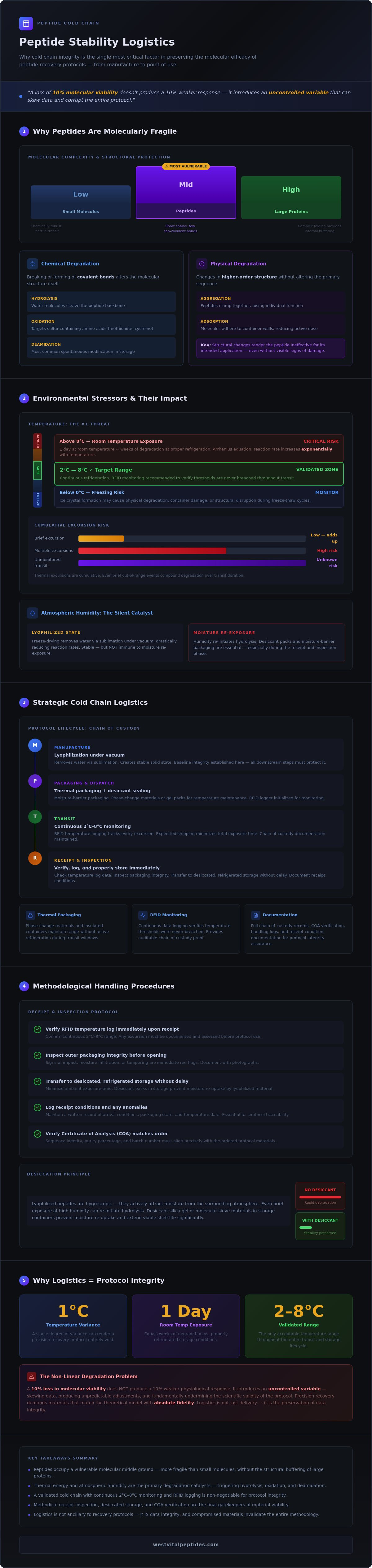
Peptide stability refers to the capacity of a molecular sequence to maintain its structural and functional integrity against the degradative forces encountered during transit and storage. Unlike small molecules, which are often robust and chemically inert, or large proteins, which may possess complex folding that offers some internal buffering, peptides occupy a vulnerable middle ground. They are relatively short chains of amino acids that lack the extensive non-covalent interactions found in larger globular proteins. This structural simplicity makes them highly susceptible to environmental stressors, necessitating a rigorous approach to peptide stability logistics to ensure the material remains viable upon arrival.
Lyophilization, or freeze-drying, serves as the primary methodology for mitigating this inherent fragility. By removing water through sublimation under a vacuum, the rate of chemical reactions is drastically reduced. This process transforms the peptide into a stable solid state, effectively pausing the biological clock that leads to degradation. However, even in a lyophilized state, molecular integrity is not guaranteed. It remains a baseline that must be protected through disciplined logistical oversight and strict adherence to environmental controls.
Chemical vs. Physical Stability
Maintaining stability requires a nuanced understanding of two distinct degradation pathways that can occur during the logistical lifecycle:
Chemical Degradation: This involves the breaking or forming of covalent bonds. Common pathways include hydrolysis, where water molecules cleave the peptide backbone, and oxidation, which frequently targets sulfur-containing amino acids like methionine or cysteine.
Physical Degradation: This refers to changes in the higher-order structure without altering the primary sequence. This includes aggregation, where peptides clump together, or adsorption, where the molecules adhere to the surface of the container walls.
The specific amino acid sequence dictates which pathway poses the greatest risk. A protocol built on compromised sequences is fundamentally flawed from its inception, as structural changes render the peptide ineffective for its intended wellness application.
The Impact of Degradation on Protocol Efficacy
Precision is the hallmark of elite recovery. When a peptide sequence experiences even marginal degradation, the physiological response becomes unpredictable. A loss of 10% in molecular viability doesn't simply result in a 10% weaker response; it introduces an uncontrolled variable that can skew data and lead to incorrect adjustments in a protocol. Professional recovery demands material that matches the theoretical model with absolute fidelity. Logistics isn't just about delivery. It's about the preservation of data integrity and the assurance that your methodology is executed with the exact materials required for success.
Environmental Stressors and Chemical Degradation Pathways
While the internal structure of a peptide defines its vulnerability, external stressors act as the catalysts for actual degradation. Effective peptide stability logistics must account for the specific environmental variables that trigger irreversible chemical alterations. Thermal energy is the most pervasive of these threats. Heat provides the activation energy necessary for most degradative reactions to proceed. Maintaining a stable environment requires more than passive cooling; it demands a proactive strategy to mitigate the kinetic energy that drives molecular decay.
Thermal Degradation Kinetics
Temperature control isn't merely about avoiding extreme heat. It's about maintaining a tight variance throughout the entire transit duration. Even brief excursions outside the recommended 2°C to 8°C range are cumulative. The Arrhenius equation provides a mathematical framework for understanding this risk; it demonstrates that the rate of chemical reactions increases exponentially as temperature rises. In practical terms, a peptide exposed to room temperature for a single day may undergo as much degradation as it would during several weeks of proper refrigerated storage. High-stakes protocols increasingly rely on RFID temperature monitoring to verify that these thresholds have never been breached.
Deamidation and Hydrolysis
Deamidation represents the most frequent chemical degradation pathway. This occurs when the side chain of an amino acid like asparagine or glutamine is chemically altered, often resulting in a change in the peptide's net charge. This process is significantly accelerated by the presence of moisture. Hydrolysis is the chemical breakdown of a compound due to reaction with water. Even when peptides are in a lyophilized state, they remain hygroscopic. If the vial seal is compromised, the powder absorbs atmospheric humidity, which triggers the hydrolytic cleavage of the peptide backbone.
Atmospheric exposure also introduces the risk of oxidation. Methionine and cysteine residues are particularly susceptible to oxygen. This can alter the peptide's biological activity and lead to inconsistent results in a recovery protocol. Additionally, certain amino acids like tryptophan and tyrosine are photo-sensitive. Exposure to ultraviolet light can cause side-chain cleavage or cross-linking. This necessitates the use of opaque secondary packaging as a standard logistical requirement. Strategic recovery depends on the absolute exclusion of these variables to maintain molecular precision. For those managing complex protocols, securing logistical assistance is a critical step in maintaining material integrity. Professional peptide stability logistics provide the necessary barrier against these environmental threats.
Strategic Cold Chain Logistics: Managing the Lifecycle of Recovery Protocols
The transition of a peptide from a controlled laboratory environment to the end user represents the most volatile phase of any recovery protocol. Maintaining molecular integrity during this window requires a strategic cold chain, defined as a continuous, temperature-controlled supply chain that spans from the point of manufacture to the final receipt. This is not merely a shipping preference; it's a rigorous logistical requirement. Without a validated cold chain, the environmental stressors identified in previous sections can quickly degrade the material, rendering the entire protocol ineffective. Precision in peptide stability logistics ensures that the material remains within the narrow thermal window required for its chemical preservation.
Modern standards in 2026 have shifted toward the integration of RFID temperature monitoring as a baseline for high-stakes logistics. These systems provide real-time visibility into the internal environment of the shipping container, allowing for immediate identification of any thermal anomalies. Validated thermal packaging, which utilizes advanced insulation materials and phase-change refrigerants, acts as the primary barrier against external heat. Secure shipping is a non-negotiable pillar of professional wellness; it provides the data-driven assurance that the material has been handled with the same discipline applied to the protocol itself.
Multi-Layered Monitoring Systems
Transparency in the supply chain is achieved through the use of sophisticated data loggers that record a complete thermal history of the shipment. These devices provide a granular view of the conditions the peptide encountered, documenting every minute of the transit duration. This level of detail is essential for building trust in the material's integrity. When a shipment experiences a temperature excursion, a formal protocol must be triggered to evaluate the extent of the exposure. If the cumulative thermal energy exceeds the stability threshold, the material is flagged as compromised. This methodological approach removes the guesswork from the recovery process, ensuring that only viable sequences are utilized.
Logistical Risk Management
Effective logistics management involves identifying and mitigating potential weak links within national shipping routes. Factors such as regional heatwaves, transit hub delays, and improper handling at transfer points can all jeopardize the stability of the payload. Expedited transit is a primary defense in this regard. By reducing the total duration of transit, the window for environmental exposure is minimized. Professionals must utilize a Peptide Logistics Management: A Methodological Framework for Protocol Integrity to navigate these complexities. This framework ensures that every logistical decision, from carrier selection to packaging configuration, is optimized to safeguard the molecular state of the recovery assets.
Methodological Handling Procedures for High-Stakes Wellness
The arrival of a shipment marks a critical transition in the lifecycle of a recovery protocol. At this juncture, the responsibility for maintaining molecular integrity shifts from the external carrier to the individual managing the protocol. A disciplined approach to receipt and inspection is mandatory. This process begins with a forensic audit of the packaging and the verification of the thermal history via the included data loggers. Any deviation from the established cold chain standards must be documented immediately. Proper peptide stability logistics don't end at the doorstep; they extend into the precise methodological handling of the material before it ever reaches the reconstitution phase.
Storage conditions must mirror the rigors of the transit phase to prevent the reintroduction of environmental stressors. Vials should be housed in a stable, dark, and temperature-controlled environment, typically a dedicated medical-grade refrigerator. Fluctuations in temperature, often caused by frequent door openings, can compromise the long-term viability of lyophilized powders. Maintaining a consistent environment is the only way to ensure that the recovery data remains accurate and the physiological outcomes stay predictable.
Equilibration and Desiccation Protocols
Atmospheric moisture is the silent enemy of lyophilized stability. When a cold vial is removed from refrigeration and opened prematurely, condensation forms instantly on the interior surfaces and the powder itself. This moisture triggers the hydrolytic degradation pathways discussed previously. To prevent this, a strict equilibration protocol is required. Vials must be allowed to reach room temperature while remaining sealed. In professional settings, the use of a desiccator—a sealed container containing drying agents—provides an additional layer of protection by maintaining a zero-humidity environment during the equilibration process. This step ensures that the peptide remains dry and stable until the exact moment of reconstitution.
Reconstitution Best Practices
The transition from a solid lyophilized state to a liquid solution is the most critical stability phase. Peptides are highly sensitive to mechanical stress during this window. Shaking a vial can cause foaming and lead to the shearing of delicate peptide chains, effectively denaturing the material. Instead, a gentle swirling motion should be used to incorporate the diluent. The choice of diluent is equally vital; high-purity bacteriostatic water is the standard for maintaining long-term stability and preventing microbial growth. It's important to recognize that once reconstituted, the degradation rate increases exponentially. For those seeking to optimize their methodology, professional logistical assistance ensures that every handling step aligns with elite standards, safeguarding the integrity of your recovery assets from receipt to application.
Professional Logistics Assistance: Safeguarding Protocol Integrity
Navigating the complexities of molecular preservation requires more than just following a basic checklist; it demands an institutional commitment to methodology and scientific rigor. Professional advisory services serve as the critical bridge between the procurement of raw materials and the execution of a successful protocol. Without expert oversight, the technical nuances of peptide stability logistics often become points of failure that compromise weeks of disciplined effort. West Vital Peptides LLC operates as an authoritative specialist in this field, providing the logistical assistance necessary to maintain protocol integrity without the distractions of retail interference or e-commerce trends.
Elite performance isn't a product of chance. It's the result of partnering with a mentor who understands the "how" and the "why" of molecular stability at every stage of the lifecycle. When you prioritize data and precision, you require a logistical framework that mirrors the intensity of your physical objectives. This specialist approach ensures that every variable, from transit thermal history to the equilibration protocols discussed previously, is managed with stoic accuracy. It's about maintaining a high stakes environment where the integrity of the material is never in question, allowing the focus to remain entirely on the physiological outcomes.
The Value of Professional Advice
Expert guidance prevents the common logistical errors that frequently compromise recovery sequences before they even begin. Many individuals inadvertently degrade their materials through improper handling or a lack of transparency in their supply chain. Transitioning from generic shipping to a professional wellness strategy allows for the implementation of rigorous standards. This methodology emphasizes transparency, ensuring you have a verifiable record of material integrity before beginning any application. Precision is a requirement, not an option, for those who value a scientific approach to their goals.
Strategic Planning and Logistical Support
Logistical support services facilitate the needs of dedicated professionals on a national scale, providing a methodological framework that leaves nothing to chance. Integrating peptide stability logistics into a broader physiological recovery strategy creates a seamless path from laboratory standards to physiological results. This strategic planning accounts for regional environmental risks and expedited transit requirements to protect your assets. By establishing a disciplined chain of custody, you eliminate the uncertainty that plagues amateur protocols. To ensure your protocol logistics meet elite standards, consult with a specialist who prioritizes the integrity of the process over the flashiness of the sale.
Securing Protocol Viability Through Methodological Logistics
Securing the integrity of a recovery protocol requires a transition from passive acceptance of shipping standards to an active, methodological oversight of every environmental variable. Molecular fragility necessitates a validated cold chain, as specific chemical pathways like hydrolysis and deamidation are triggered by even minor lapses in handling. True excellence in this field isn't achieved through shortcuts or retail trends; it's the result of applying the same scientific rigor to your materials that you apply to your physical training. Precision at the molecular level is the only way to ensure the data from your recovery efforts remains reliable and actionable.
Adopting a disciplined approach to peptide stability logistics ensures that your recovery assets remain viable from the point of manufacture through to final application. This process demands a partner who understands the mechanics of physiology and the complexities of high stakes logistics. Under the professional oversight of Coach West, our national advisory services provide the framework required for elite performance and protocol coordination. To safeguard your material integrity and optimize your recovery outcomes, Inquire about Professional Logistical Assistance and Wellness Advisory today. Your commitment to methodological discipline is the most reliable path to achieving your elite performance goals.
Frequently Asked Questions
What is peptide stability and why does it matter for my wellness protocol?
Peptide stability is the capacity of a molecular sequence to resist chemical or physical degradation during transit and storage. This matters because a protocol is only as reliable as the materials used; compromised peptides introduce uncontrolled variables that skew physiological data. Maintaining molecular integrity ensures that the expected biological response aligns with your strategic recovery objectives and prevents protocol failure due to inactive materials.
Does shipping peptides in the summer affect their integrity?
Seasonal temperature increases significantly elevate the risk of thermal degradation during transit. Elevated ambient heat provides the activation energy necessary for chemical reactions like hydrolysis to occur more rapidly. High stakes peptide stability logistics mitigate this risk through validated thermal packaging and real-time RFID monitoring to ensure the material remains within specified temperature thresholds despite external environmental stressors.
What is the difference between lyophilized and reconstituted peptide stability?
Lyophilized peptides are in a solid, freeze dried state that effectively pauses most degradative chemical reactions by removing moisture. In contrast, reconstituted peptides have been introduced to a liquid diluent, which increases their molecular mobility and subjects them to exponential degradation rates. While lyophilized powders remain stable for extended periods under proper conditions, reconstituted solutions require immediate refrigeration and possess a significantly shorter window of viability.
How should I store peptides once they arrive at my location?
Peptides should be stored in a dedicated, medical grade refrigerator that maintains a consistent temperature between 2°C and 8°C. The storage environment must be dark to prevent photo degradation and stable to avoid the cumulative effects of thermal excursions caused by frequent door openings. Proper storage is a critical continuation of the logistical chain of custody required to preserve the precision of your recovery protocol.
Why is a professional logistics partner necessary for wellness protocols?
A professional logistics partner provides the technical oversight and methodological framework necessary to navigate complex supply chain variables. They ensure transparency in the cold chain and provide the data loggers required to verify material integrity upon receipt. This partnership removes the uncertainty of shipping standards, allowing you to focus on the execution of your wellness strategy with verified materials.
Can I tell if a peptide has degraded just by looking at the vial?
Visible inspection is insufficient for determining molecular integrity, as chemical changes like deamidation or oxidation don't alter the appearance of the lyophilized powder. Degradation occurs at the molecular level and can only be identified through laboratory analysis or by reviewing the thermal history recorded during transit. Relying on visual cues is a breach of disciplined protocol management that compromises the accuracy of your results.
What are the risks of using peptides that have undergone thermal degradation?
Using peptides that have undergone thermal degradation leads to inconsistent physiological outcomes and a loss of precision in recovery data. When a sequence is compromised, its biological activity is reduced or altered, which renders the resulting protocol data invalid. This creates a significant risk of protocol failure and wastes the time and resources invested in a disciplined, data driven recovery strategy.
How does West Vital Peptides LLC assist with logistical management?
West Vital Peptides LLC provides professional advisory and logistical assistance to ensure the structural integrity of your recovery sequences. Our approach, led by Coach West, utilizes a methodological framework to manage the lifecycle of your protocol materials nationally. We prioritize transparency and scientific rigor in peptide stability logistics to safeguard the molecular state of your recovery assets without retail interference.


Comments